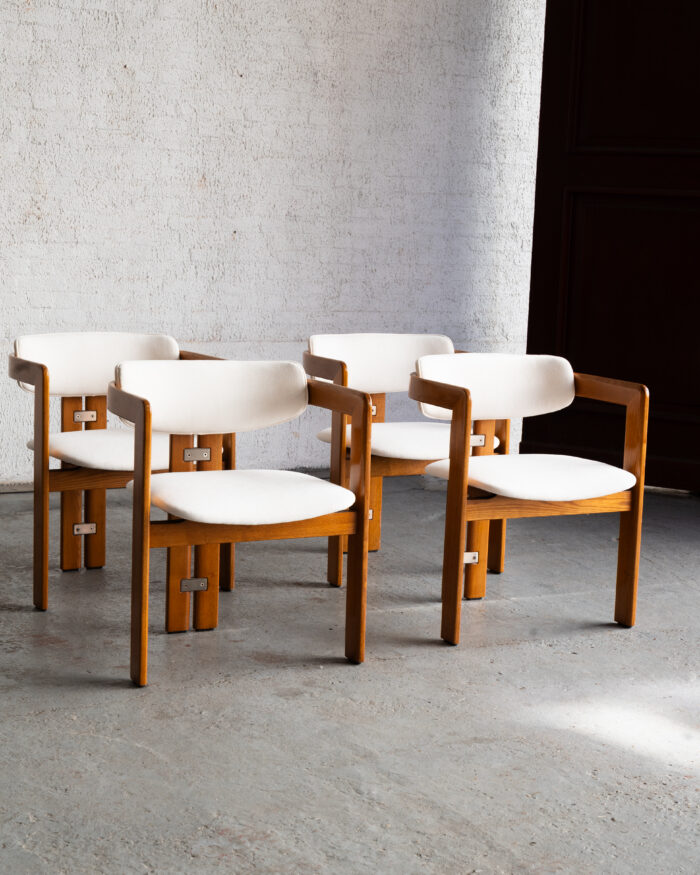
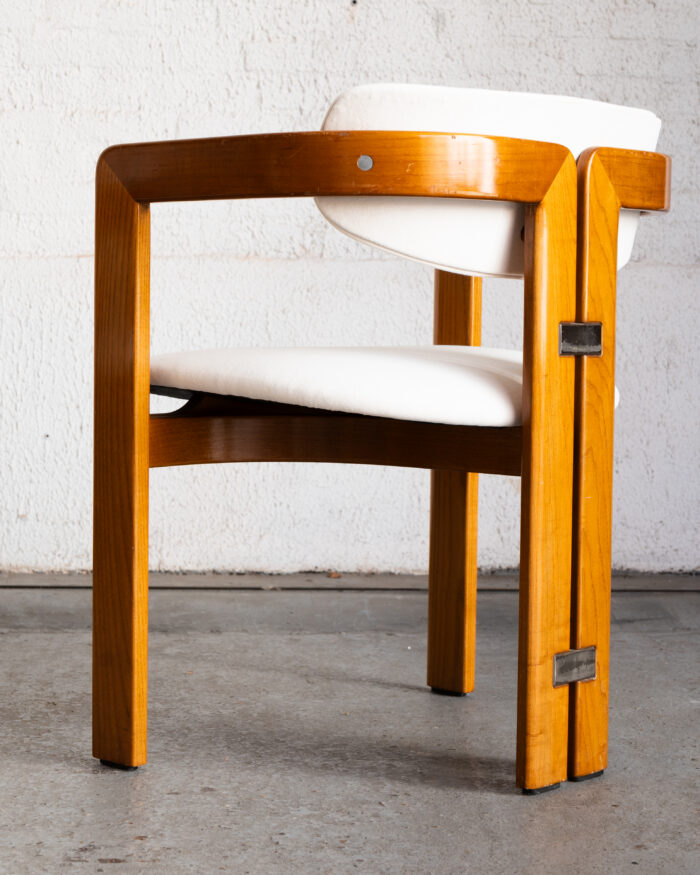
Set of 4 dining chairs ‘Kastrup’ by Louis Van Teeffelen, 1960’s (Sold)
This set of 4 ‘Kastrup’ dining chairs was designed by Louis Van Teeffelen and produced by Wébé in the Netherlands in the 1960’s. The organic backrests make for a very comfortable chair, suitable for long dining evenings. This set has been restored completely. A few missing parts of the veneer on the backrests and bite marks on the legs have been restored. The frames were varnished again to withstand any spilled water. The seatings were re-upholstered in a light mouse grey quality fabric. The slightly slanted positioning of the legs and the use of two tones of wood for the veneer top and solid teak legs are trademark features of Louis Van Teeffelen’s design. We have a matching round table by the same designer available as well.
Product / Model
Designer
Manufacturer
Country
Date
Product ID
Price
Dimensions:
W: 47 cm
D: 49 cm
H: 75 cm
Seating H: 45
Weight: approx. 6 kilo/piece
Material: teak, fabric
Designer Louis Van Teeffelen (29th of sept 1921) is best known for his work as chief designer for the furniture factory Walraven and Bevers, later known as Wébé.
Louis lost his father, who was a blacksmith, when he was only 4 years old. Because of the outbreaking war and his own difficult family situation, Louis couldn’t go attend a higher vocational school or academy. He studied furniture design and technical manufacturing in the evenings at the Royal PBNA (Polytechnic Bureau Netherlands Arnhem). After the war, he also earned a diploma in self-employment and general business knowledge.
In 1952 he went to work for himself as a designer, collaborating with a construction company called Baars and Sons. This company went bankrupt only three years later, taking Van Teeffelen’s firm down along with it.
From 1955 to the end of 1967, he became the chief designer for Walraven and Bevers, later renamed Wébé. During the post-war years, a lot of new houses had to be built in The Netherlands. These houses had to be light, modern and easy to build, thanks to new techniques that were introduced. With the new housing came a new style of furniture. Away with the heavy old oak pieces, the new style was inspired by Danish designers with their minimalism and functionalist approach.
It was a period when Wébé produced high-quality furniture in teak or rosewood, sometimes walnut and wenge. At the time, Wébé was one of the larger furniture factories in the Netherlands. Van Teeffelen was heavily inspired by Kaare Klint and other Danish designers but did put his own stamp on his designs. His pieces were organic with sculptural elements like the recognisable ‘smiley’ handgrips. The seatings were of a phenomenal comfort and very practical. His modular wall system became very popular overnight and his coffee tables showed a familiarity with Japanese aesthetics. In later years, he integrated other materials, like glass or cermaic tile panels made by Jaap Ravelli, a ceramist from Valkenburg.